
Summarize with AI





Why the log matters
Rental work rarely arrives as one neat project. It shows up as a call with a cleaner, a drive to the property, a repair, a supply run, and a follow-up message spread across the week. By month-end, the order and detail are already harder to reconstruct.
A useful work log is an operational history: what happened, when it happened, who was involved, and what still needs attention. It gives you and your team a shared record without turning every small task into paperwork. A structured activity record can also make the later review and export process much calmer.
Its purpose is to preserve clear facts for later review, not to reach a tax or legal conclusion.
Capture the facts that are hard to reconstruct
A strong entry answers five simple questions:
- When and where: the date and the property.
- Who: the owner, teammate, vendor, cleaner, or other person involved.
- What: the task and its outcome, written in plain language.
- How long: the actual duration, captured before it becomes a rounded guess.
- What supports it: a receipt, photo, invoice, calendar clue, or follow-up note when useful.
Example entry: August 14 · Mountain Cabin · 1 hr 20 min
Replaced the leaking kitchen faucet, tested the shutoff valves, photographed the finished repair, and attached the hardware-store receipt. No follow-up needed.
The example is short, but another person can still understand the work, outcome, time, and supporting context. That is the standard worth aiming for.
Use a routine small enough to repeat
- Capture a rough entry within minutes of finishing the work.
- Before saving, confirm the property, person, date, duration, and outcome.
- Attach evidence when it helps explain or support the activity.
- Each week, resolve incomplete notes and add missing outcomes while they are still recent.
- Review the month as a whole for gaps, duplicates, and entries that are too vague to be useful.
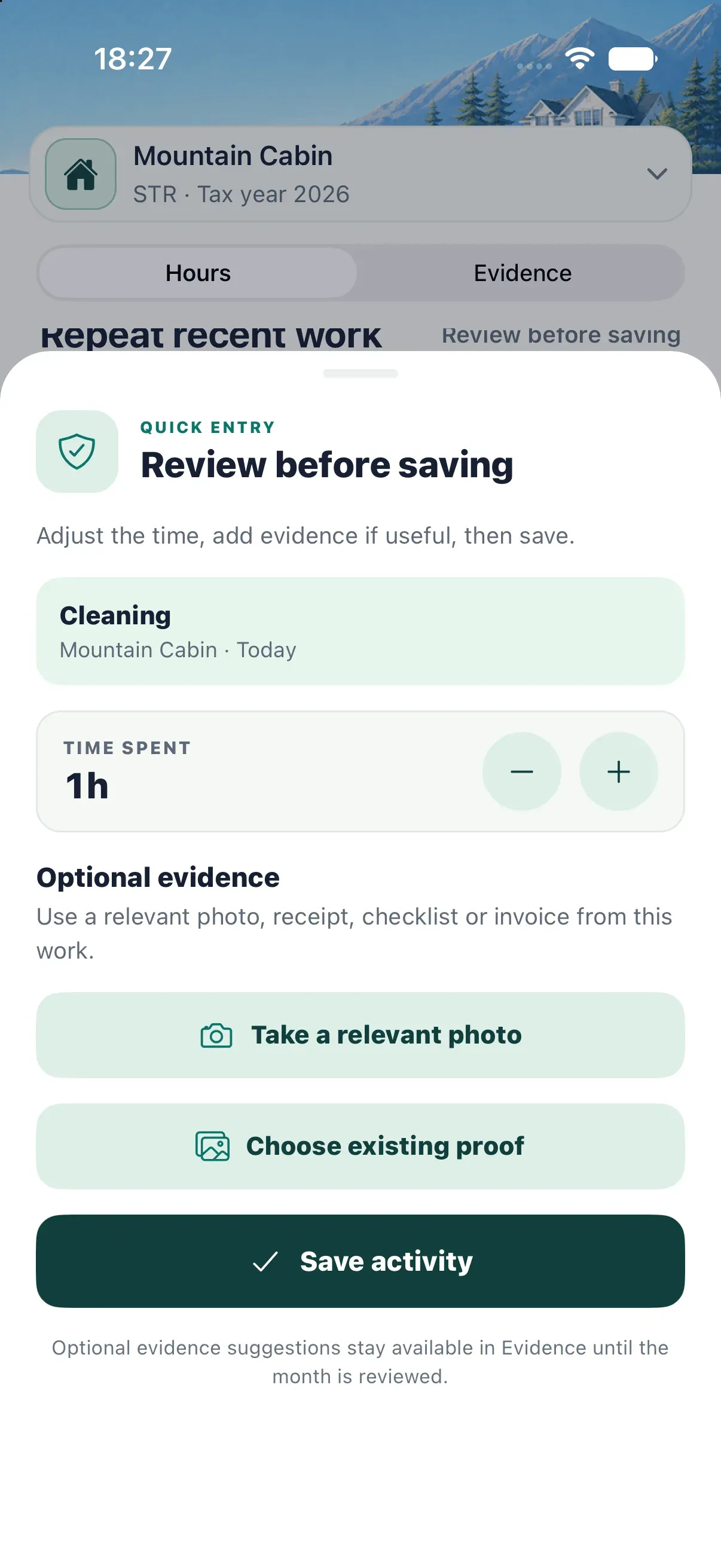
Review the important details while the work is still fresh.
Consistency beats detail overload. A concise entry made on time is usually more useful than a perfect entry you postpone until the end of the month. The HostHours capture workflow is designed around that review-before-save habit.
Review before you hand anything off
Before exporting or sharing a log, look for:
- missing or obviously rounded durations,
- notes that describe an intention instead of the work actually completed,
- unnamed people or properties,
- open follow-ups with no final outcome, and
- duplicate entries created from the same calendar event, receipt, or conversation.
A reviewed log gives a property manager, bookkeeper, or CPA better context. It does not replace their professional judgment, and the presence of an entry does not determine its tax, accounting, or legal treatment.
A five-minute starter checklist
- Create the property and the people who regularly work on it.
- Choose a few clear activity categories instead of an exhaustive list.
- Log today’s most recent task before adding older history.
- Set one weekly reminder to review incomplete entries.
- Keep original receipts, invoices, photos, and other important source files separately.
Start with the next real task. Once the habit works, add detail only where it improves review or handoff. You can explore the rest of the HostHours journal as more practical rental-operation guides are published.
Note: This article provides general educational information, not tax, legal, accounting, financial, or compliance advice.
Clear answers
Frequently asked questions
What should a rental property work log include?
Record the date, property, person involved, task completed, outcome, actual duration, useful supporting context, and any follow-up that is still needed.
When should I record rental property work?
Create the entry as soon as practical after completing the work, while the sequence, duration, and outcome are still fresh. A short accurate note is more useful than a detailed entry reconstructed weeks later.
How detailed should each rental work-log entry be?
Include enough detail for another person to understand what happened, how long it took, and what remains open. The entry does not need to be an essay when those facts are already clear.
Do I need to attach a receipt or photo to every entry?
No. Add receipts, photos, invoices, or calendar context when they help explain or support the activity. Keep important original source files separately even when a copy is attached to the log.
How often should I review a rental property work log?
Check each entry before saving, review incomplete items weekly, and scan the full log monthly for missing details, duplicates, vague descriptions, and unresolved follow-ups.
Does a work log determine how an activity is treated for tax purposes?
No. A work log preserves factual information, but it does not determine tax, accounting, or legal treatment. Discuss those conclusions with an appropriately qualified professional.